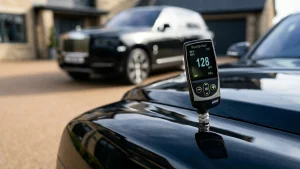


The ‘All-Weather’ Lie. A mobile valeter tells you he can ceramic coat your car on your driveway in January. He says: “It will be fine, mate. I use high-quality stuff.”
He is lying. Or worse, he does not understand physics.
Temperature matters. Ceramic coatings are not paint; they are a chemical reaction. If you try to apply a professional ceramic coating in the freezing cold, the chemistry stops working. Most detailers will take your money, apply the coating, and drive away. Two weeks later, that expensive coating will fail.
The Science: The 10°C Rule (Arrested Curing)
Most clients think that once the coating is wiped on, the job is done. That is wrong. The application is just the start. The coating needs to “cross-link” (harden) to bond with your clear coat.
This reaction requires heat. For most professional coatings (SiO2), the magic number is 10°C.
If the panel temperature drops below 10°C, the reaction stalls. We call this Arrested Curing. The coating might look shiny when the detailer leaves, but it hasn’t bonded. It remains soft at a molecular level. One heavy rain later, it washes away. You have essentially flushed £500 down the drain.
The Hidden Killer: ‘Condensation Shock’
Even if the air temperature is mild, there is a second invisible enemy: Moisture.
Think of a cold beer can on a warm day. Water droplets form on the outside instantly. The same thing happens to your car panels. In the UK winter, if the metal of your car hits the Dew Point, invisible condensation forms on the surface.
If a detailer applies a coating over this invisible moisture layer, the coating cannot touch the paint. It sits on top of the water. This leads to Delamination. The coating peels off, leaving your paint unprotected.
The Streetcraft Solution: The Integrity Protocol
| Feature | Ceramic Coating (Applied <10°C) | Polymer Sealant (Streetcraft Protocol) |
|---|---|---|
| Chemistry | Requires Heat to Cross-Link | Chemically Engineered for Cold |
| Curing Risk | Stalls ("Arrested Curing") | Instant Cure |
| Bonding | High Risk (Delamination) | Strong Bond in Low Temps |
| Outcome | Fails/Clouds in Weeks | 6 Months Salt Protection |
We are not “Fair Weather” detailers, but we are honest ones. We cannot cheat physics.
When you book a Ceramic Detail in winter, we assess the environment first.
Scenario A: You have a heated garage. Perfect. We can control the temperature and humidity. We will proceed with the full Ceramic Application as planned.
Scenario B: You are parked outside. If it is 4°C on your driveway, we will refuse to apply a standard Ceramic Coating. We would rather lose the sale than sell you a failure.
Instead, we switch to our Winter Protection Protocol. We apply a specialised Polymer Sealant. Unlike ceramics, these polymers are chemically engineered to cure in cold temperatures. They provide up to 6 months of heavy-duty protection against salt and grit. This keeps your asset safe through the worst of the winter.
Once Spring arrives and the temperatures rise above 10°C, we can return to apply the permanent Ceramic Coating.
FAQ
What is the minimum temperature for ceramic coating? Generally, the panel needs to be above 10°C for the chemicals to bond properly. If you don’t have a garage, do not let anyone apply one in January.
Why does my ceramic coating look cloudy? This is often “blooming” caused by moisture (Condensation Shock) trapping inside the coating during the curing phase.
Can I still protect my car in winter without a garage? Yes. But not with a Ceramic Coating. You need a Polymer Sealant or a high-grade wax that can bond in cold weather. This is what we use in our Winter Logistics packages.
Don’t Gamble With Chemistry
Your car is an asset. Don’t let a budget detailer ruin it with bad science. If the conditions aren’t right, we will tell you the truth. Book a Winter Protection Detail today, and plan your Ceramic Coating for Spring.