

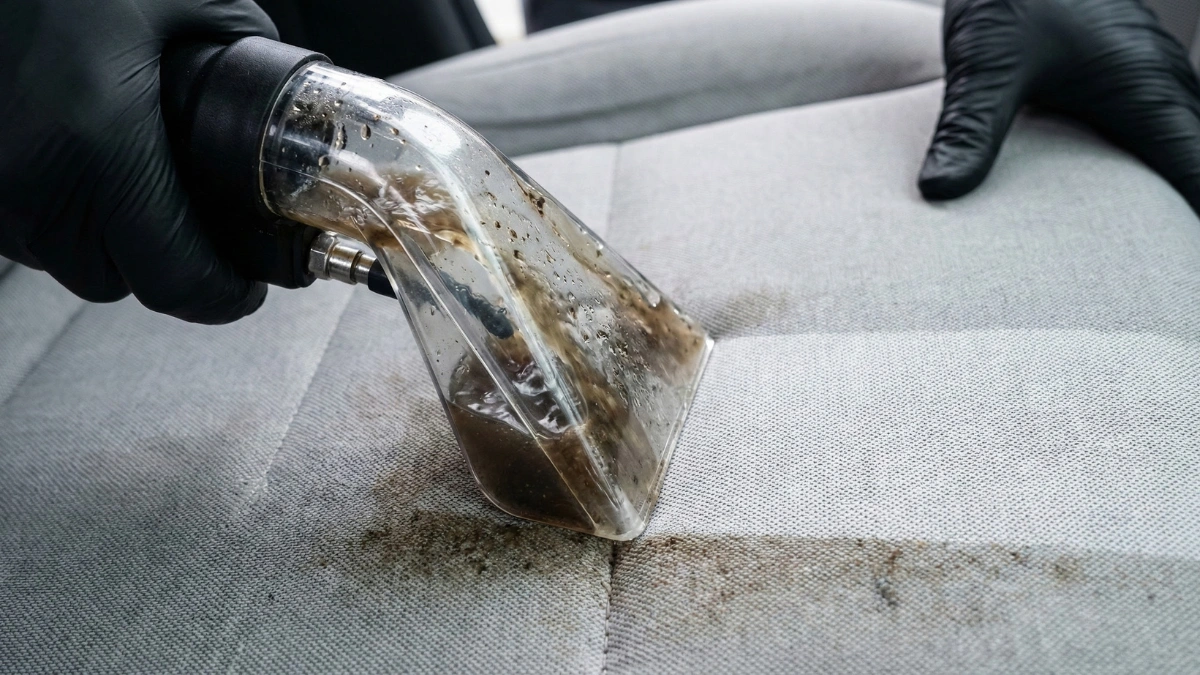
You open your car door. You are hit by a smell. It smells like old socks. Maybe it smells like a wet dog. You check your boots. They are clean. Then you look at the seatbelt. You look at the side of the passenger seat. You see it. White fuzz. Green spots. It is mould. Your car is not just dirty. It is infected.
Most people panic when they see this. They pull out their phone. They start searching for tips on cleaning car mould with vinegar. They see the same advice over and over again. “Use white vinegar.” “Use bleach.” “Scrub it with a toothbrush.”
I need you to listen to me very carefully. Do not do this. If you pour vinegar or bleach on your car interior, you are making a massive mistake. You might think you are cleaning. Actually, you are damaging your safety equipment. And you are feeding the fungus.
We are Streetcraft Detailing. We deal with this every day. We are going to explain why the home remedies fail. And we are going to show you the only safe way to fix it.
Diagnosing the Damp: Is it Mildew or Mould?
Does it matter what we call it? Not really. If it is growing, it is a problem. Mildew is usually flat. It looks like a powder. Mould is thicker. It is fuzzy. It has texture.
Both of them are fungi. Both of them release spores into the air. When you sit in your car, you are in a sealed box. You turn on the heater or the AC. You blow those spores right into your face. You breathe them in.
This causes coughing. It causes wheezing. It can trigger asthma attacks. The NHS has clear warnings about the health risks of mould. This is not something you ignore. And it is not something you fix with a wet wipe.
The ‘Kitchen Sink’ Trap: Why Vinegar Feeds the Fungus
Let’s talk about the vinegar myth. It sounds logical. Vinegar is an acid. Acids kill things. So if you spray vinegar on the seat, the mould should die.
Here is the problem. Vinegar is mostly water. Usually it is about 95 percent water. Mould needs moisture to survive. That is why it is there in the first place. Your car has a leak. Or a spill. Or a damp carpet.
When you spray vinegar on a foam seat, the acid stays on top. It kills the surface fuzz. It looks like it worked. But the water soaks down. It goes deep into the foam cushioning.
The mould has roots. These roots are called mycelium. They live deep inside the foam. The vinegar water feeds these roots. You are literally watering the fungus.
Give it two weeks. The mould comes back. And this time it is stronger. It smells worse. You created a perfect environment for regrowth.
The Silent Danger: Why You Must Never Bleach or Vinegar a Seatbelt
This is the most important part of this article. Please pay attention. If you have mould on your seatbelts, you must be extremely careful.
Seatbelts are made of nylon webbing. Nylon is strong. It saves lives. But nylon has a weakness. It is weak against strong acids and strong alkalis.
Vinegar is an acid. Bleach is an alkali. If you soak a seatbelt in vinegar to kill the mould, a chemical reaction happens. It is called hydrolysis. The acid attacks the bonds in the nylon fibres.
You cannot see this damage. The belt looks clean. It looks normal. But the fibres are unravelling at a microscopic level. The tensile strength drops.
Now imagine you are in a crash. You hit the brakes hard. Or you hit another car. Your body is thrown forward with massive force. The seatbelt is supposed to catch you. But you weakened it with vinegar. The belt snaps.
This is a known fact in the industry. Manufacturers like Volvo issue strict warnings against using chemical cleaners on belts. You can read the Volvo manufacturer warning yourself. They state clearly that you must only use water and synthetic detergent. Never harsh chemicals. Is a clean looking belt worth the risk if it fails when you need it? Absolutely not.
The Science of Steam: How Hot Water Extraction Works
So how do we kill the mould without killing the seatbelt? And how do we kill the roots deep in the foam? We use physics. We use heat. We use the Streetcraft Deep Clean process.
This is not a spray bottle. This is industrial machinery. We use a method called Hot Water Extraction. Some people call it steam cleaning. But it is more than just steam. Here is the process.
Step 1: The Kill Phase We inject superheated water and steam into the fabric. This is hot. It is hot enough to thermally shock the mould spores. They die instantly. They cannot survive the temperature.
Step 2: The Extraction Phase Killing the mould is not enough. Dead mould spores are still toxic. They can still cause allergic reactions. We have to remove them physically.
Our machine uses a powerful vacuum. It injects the steam and sucks it back out in the same second. It pulls the moisture out. It pulls the dirt out. It pulls the dead mould spores out. It pulls the roots out of the foam.
We do not leave the water behind. We extract it. This leaves the seat damp but not soaking. It removes the food source for the mould.
Step 3: The Chemical Phase We use professional bio cleaners. These are pH neutral. They are safe for nylon seatbelts. They are safe for your family. They stop the mould from coming back. But they do not burn the fibres of your safety equipment.
We Come to You: Mobile Deep Cleaning Solutions
You might be thinking about logistics. “My car is full of mould. I do not want to drive it.” We agree. You should not be driving a car filled with spores. It is a distraction. It makes your eyes water. It is bad for your lungs.
That is why we are a mobile service. Streetcraft Detailing comes to your house. We come to your workplace. We bring our own power. We bring our own water. We have the industrial extractors in our van.
You stay inside where it is warm and safe. We put on the masks. We suit up. We handle the biohazard. You do not have to lift a finger.
Book Your Mould Remediation Today
Do not gamble with your health. Do not gamble with your safety belts. Vinegar is for chips. Not for cars.
If you can smell damp, the problem is already deep in the seats. You need a professional extraction. You need the Deep Clean Package.
Let us reset your car to a safe standard. We guarantee to remove the odour. We guarantee to remove the spores.
Click the link below. Book Your Mould Remediation