

It is a crisp winter morning.
You walk out to your car.
It is covered in a thick white layer of road salt.
You know that salt is eating away at your paintwork. You know it is rotting the metal underneath.
But you hesitate.
It is freezing outside. The thermometer reads 0°C.
You have heard the horror stories.
You have heard about doors frozen shut. You have heard about locks that refuse to turn. You have heard about windscreens cracking under hot water.
So you are stuck.
Do you leave the salt to rot your car?
Or do you wash it and risk being locked out tomorrow morning?
This is the dilemma every UK driver faces in January.
Most people panic. They do nothing. They let the corrosion set in.
Others try to be clever. They use “hacks” they saw on social media. They pour boiling water. They use cooking oil on their seals.
These people usually end up with a broken car.
We are going to stop you from making those mistakes.
We are going to teach you the Streetcraft Protocol.
This is how you wash a car in freezing weather without destroying it.
The 4°C Rule: When is it Too Cold to Wash?
You need a hard rule to follow.
We use the 4°C Rule.
If the air temperature is above 4°C, you are generally safe. The water will stay liquid long enough for you to dry it.
If the temperature drops below 4°C, the risk spikes.
Water does not just dry in these conditions. It freezes.
It freezes on your paint. It freezes in your door handles. It freezes on the ground around you.
If you wash your car at 0°C without a plan, you are turning your driveway into an ice rink.
You are also coating your car in a layer of ice that can jam delicate parts.
Does this mean you can never wash your car in the cold?
No.
It means you cannot wash it carelessly.
You need to change your technique. You need to understand the physics of what is happening to your vehicle.
If you just blast it with a hose and walk away, you will regret it.
The ‘Hot Water’ Myth: Why Boiling Water Breaks Glass (The Physics)
Let’s deal with the biggest myth first.
You have seen it on the news. You have seen neighbours do it.
They boil the kettle. They march out to a frozen car. They throw the boiling water over the windscreen to clear the ice.
This is arguably the most dangerous thing you can do to a vehicle.
It is not a “hack”. It is vandalism.
It causes something called thermal shock.
Your windscreen is not just a sheet of glass. It is a sandwich.
It is made of two layers of glass with a plastic layer (PVB) in the middle.
When your car sits in freezing temperatures, the glass contracts. It shrinks. It becomes brittle.
When you hit that cold glass with boiling water, you force a rapid expansion.
The glass wants to expand instantly.
But the cold air outside is still pushing back.
The glass expands at a different rate to the plastic layer inside.
The stress is too much. The glass cannot handle the sudden change in size.
It snaps.
You might get away with it once. You might get away with it twice.
But eventually, physics will win.
A tiny stone chip you didn’t even notice will turn into a massive crack instantly.
Never use hot water on glass.
Use lukewarm water if you must. Or better yet, use a proper de-icing spray.
Do not gamble with a £500 windscreen replacement.
Frozen Seals vs. ‘Latch Bounce’: Know the Difference
You go to open your car door. It won’t move.
You pull harder. Nothing happens.
Most people say “my door is frozen”.
But there are actually two different problems here.
You need to know which one you have. The fix is different for each.
Problem 1: The Frozen Seal
This is when the rubber seal around the door freezes to the metal body of the car.
Water gets in the gap. It turns to ice. It acts like glue.
When you pull the handle, the door feels stuck solid.
If you pull too hard, you will rip the rubber seal right off the metal.
This creates a leak. Next time it rains, your footwell will be wet.
Problem 2: The Latch Bounce
This is more annoying.
You pull the handle. The door opens. Success.
You get in. You pull the door shut.
It bounces back.
You try again. You slam it harder.
It bounces back again.
The door will not latch.
This is not caused by ice on the rubber. This is caused by the grease inside the lock mechanism.
Car manufacturers put thick grease inside the door latch to keep it smooth.
In the summer, this grease is soft and oily.
In freezing temperatures, the grease gets thick. It becomes like glue.
When you pull the handle, a spring inside the lock pulls the latch open.
When you let go, the spring tries to push the latch back.
But the grease is too thick. The spring is not strong enough to push through the sludge.
The latch stays in the “open” position.
So when you try to close the door, the metal hook hits a closed latch. It bounces off.
Slamming the door will not fix this. It will only break the plastic parts inside the lock.
You need warmth. You need to melt that grease.
Why Pros Use ‘Gummi Pflege’ (And Why WD-40 Ruins Rubber)
So how do we prevent the rubber seals from sticking?
We need to treat them.
But you must use the right chemical.
Bad advice is everywhere.
The AA once suggested using cooking oil on door seals.
Do not do this.
Cooking oil goes rancid. It rots. It smells bad. It attracts dirt.
Other people suggest standard WD-40.
Standard WD-40 is a solvent. It is designed to clean metal. It is not a lubricant for rubber.
If you put solvents on your rubber seals, you dry them out.
Over time, the rubber swells. It gets soft. It loses its shape. It starts to crumble.
You need a product designed for EPDM rubber.
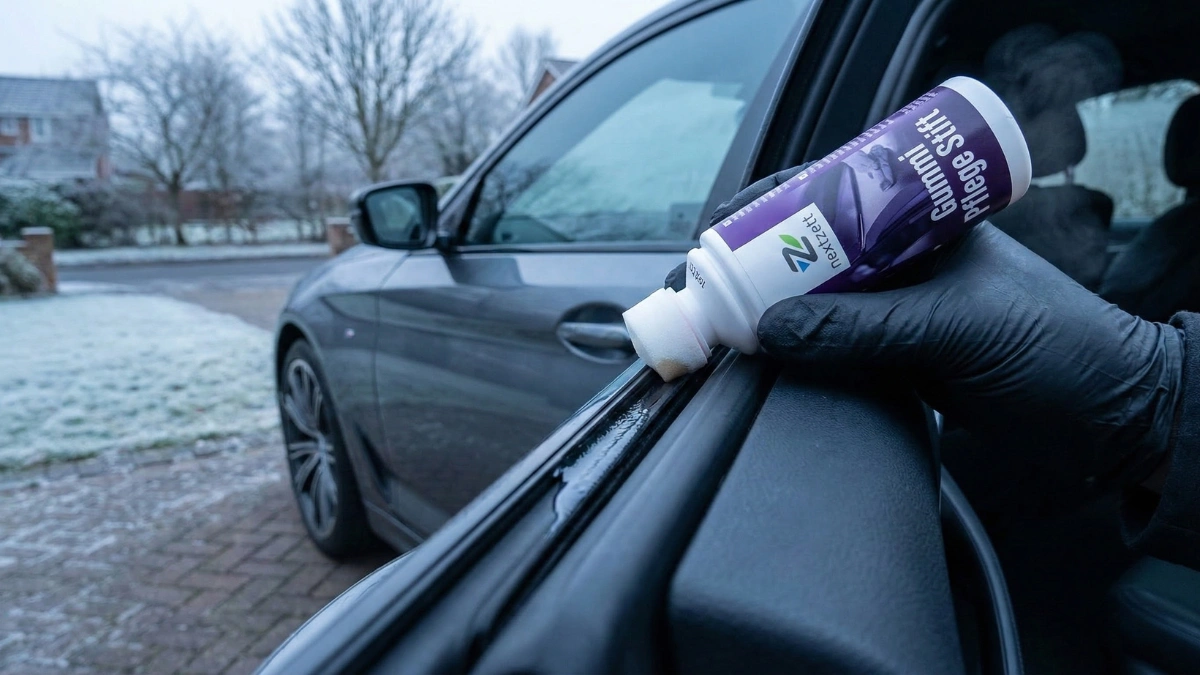
We use Gummi Pflege.
This is a German product. The name literally means “Rubber Care”.
It is not oily. It is a water-based conditioner.
It feeds the rubber. It keeps it soft and flexible.
Most importantly, it leaves a dry barrier on the surface.
Ice cannot stick to this barrier.
If you treat your seals with Gummi Pflege, your doors will not freeze shut.
It is cheap. It takes five minutes. It saves you hours of frustration.
The Streetcraft Protocol: How to Wash Safely in Winter
You know the risks. You have the right tools.
Now we wash.
Follow this protocol exactly. Do not skip a step.
Step 1: The Pre-Heat
Start your engine.
Turn the heaters onto “High”.
Direct the air at the floor and the windscreen.
Turn on the heated rear window.
Let the car warm up for 15 minutes before you touch a drop of water.
This warms the glass. This warms the metal door panels.
This warmth will radiate out to the seals. It helps prevent the water from freezing instantly when you start washing.
Step 2: The Wash (Keep it Brief)
Do not spend hours detailing the wheels.
This is a maintenance wash. The goal is to remove salt.
Use your pressure washer to blast the salt from under the wheel arches.
Wash the paint quickly.
Keep the water away from the door locks if you can.
Do not aim the pressure washer directly into the gap between the door and the handle.
You are trying to keep water out of that latch mechanism.
Step 3: The Air Purge (Critical)
This is where most people fail.
They towel dry the paint and walk away.
You must get the water out of the hidden areas.
Open every door. Open the boot. Open the bonnet.
Look at the door shuts. Look at the metal frame.
It will be soaking wet.
If you close the door now, that water will freeze tonight. Your door will be welded shut by morning.
Use a thick drying towel. Wipe every inch of the metal door frame.
Wipe the rubber seals until they are bone dry.
If you have a leaf blower or a car dryer, use it.
Blast air into the door handles. Blast air into the wing mirrors. Blast air into the lock mechanism.
You need to force every drop of water out.
Step 4: The Barrier
Once the rubber is dry, apply your Gummi Pflege.
Run the stick along every rubber seal.
Do not forget the boot seal.
Do not forget the sunroof seal if you have one.
Step 5: The Latch Lube
If your locks feel stiff, do not use standard WD-40.
Use a PTFE spray or a white lithium grease spray.
These lubricants can handle the cold. They do not get thick like old grease.
Give a tiny spray into the latch mechanism. Move the latch back and forth with a screwdriver to work it in.
Let Us Handle the Freeze: Book a Winter Detail
Washing a car in zero degrees is miserable work.
Your hands go numb. The water turns to ice on your driveway.
And if you make a mistake, you can damage your paintwork.
Why put yourself through that?
Stay warm inside your house. Let us handle the cold.
We come to you fully equipped to battle the elements.
We use commercial blowers to remove every drop of water before it freezes.
We apply professional sealants that stop road salt from destroying your paint.
We treat every rubber seal with Gummi Pflege as standard.
We guarantee your car will open the next morning.
Secure Your Winter Slot Today
Don’t let the salt win.
Book a Winter Detail with Streetcraft.
We will strip the salt. We will protect the paint. We will weatherproof your locks.
Drive with certainty this winter.